

Last updated: March 2026
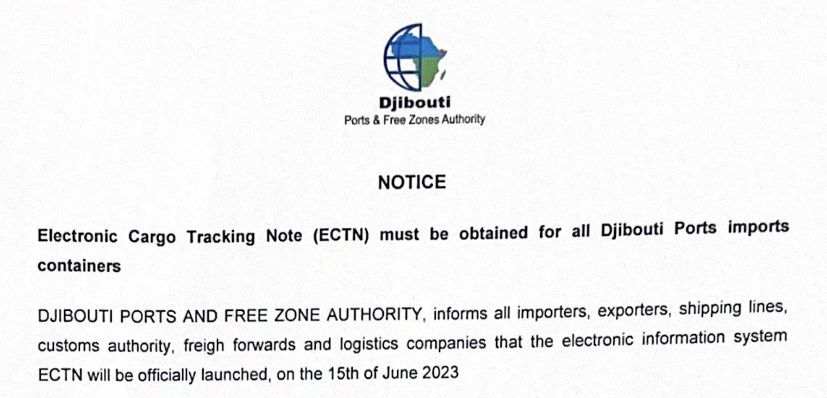
A Djibouti ECTN certificate (Electronic Cargo Tracking Note) is a mandatory shipping document required for all cargo entering or transiting through Djibouti. Starting on June 15, 2023, the Djibouti Ports and Free Zone Authority made it a requirement that all shipments — including transit shipments — obtain a Djibouti ECTN. The law applies to all commodities without any exceptions, and the ECTN reference number must be included on the bill of lading. Without it, exporters face fines of twice the CTN cost plus regulation fees.
We offer Djibouti ECTN certificates forUnited States .
Djibouti is one of Africa’s most strategically located ports, handling trade for over 100 million people in the Horn of Africa and landlocked Ethiopia. The Port of Djibouti handles approximately 95% of Ethiopia’s international trade (Source: World Bank), making ECTN compliance essential for exporters to the region. For general information, see our guide on what is a CTN certificate.
Table of Contents
- What is an ECTN Certificate?
- Required documents
- Consequences of not having ECTN
- Pricing
- How long does it take?
- Which ports require ECTN?
- Related certificates you may need
What is an ECTN Certificate?
ECTN is an abbreviation for Electronic Cargo Tracking Note. This certificate empowers authorities to effectively track, manage, and supervise all cargo from loading to discharge. It provides valuable information about shipments before they reach their destination, including details about the exporter, importer, transported goods and their value, freight costs, shipment type, vessel name, and more.
The ECTN is used across Africa under different names in each country — for example, it’s called BSC/BESC in French-speaking West Africa, FERI in DR Congo, and ACD in neighboring Sudan. Djibouti is one of the newest countries to implement this requirement, joining over 25 African nations that mandate cargo tracking certificates.
What are the required documents?
There are 3 required documents for the Djibouti ECTN process:
- Bill of Lading: It is a document that provides information about the exporter, the importer, the weight of the goods, the shipping line, the vessel name, etc.
- Commercial Invoice: It contains details of the goods, the freight cost, the incoterm, and some other charges if there is any, etc.
- Freight Invoice: It is a document only necessary if the freight cost isn’t on the commercial invoice.
Make sure all documents are accurate and complete before submission. See our guide on the top 20 mistakes to avoid when getting a CTN to prevent costly errors.
What are the consequences of not having this certificate?
It is essential to possess this certificate at least five days before the vessel’s arrival at the destination port. Failure to comply may result in a fine equivalent to twice the CTN cost, in addition to a regulation fee.
Given Djibouti’s role as the primary trade gateway for landlocked Ethiopia and the broader Horn of Africa, delays at port can have major supply chain consequences. Learn more about why outsourcing your CTN to an experienced provider helps avoid these risks.
Pricing
Certificate cost depends on the number of Bill of Ladings and the containers, the country of origin, the port of discharge, etc. If you share your shipment’s details with us we can provide you the best charges for your certificate. We offer free quotations — contact us or see our pricing page for more details.
How long does it take to get Djibouti ECTN certificate?
We provide draft Djibouti ECTN certificates within 24 hours. We provide certificates to exporters all over the World.
Which ports in Djibouti require ECTN certificate?
All ports in Djibouti require an ECTN certificate. Djibouti’s port infrastructure has expanded significantly in recent years, with over $3.5 billion invested in port development (Source: Djibouti Ports and Free Zones Authority). The major ports include:
- Doraleh Multipurpose Port (DMP):
The newest and most modern port in Djibouti, opened in 2017. It handles containers, general cargo, and bulk commodities with a capacity of over 7 million tonnes per year. - Doraleh Container Terminal (DCT):
A dedicated container terminal with deep-water berths capable of handling the largest container ships. It is a major transshipment hub for East Africa. - Old Port of Djibouti:
The original port in Djibouti city, now primarily handling smaller vessels, livestock exports, and local trade. - Port of Tadjoura:
Located on the northern coast, this port primarily handles salt exports and serves the northern regions of Djibouti.
Related Certificates You May Need
If you’re shipping to or through countries near Djibouti, you may also need one of these certificates:
- Somalia CTN — required for cargo entering Somalia, Djibouti’s southeastern neighbor
- Sudan ACD — required for cargo entering Sudan (Advance Cargo Declaration)
- Yemen ACD — required for cargo crossing the Gulf of Aden to Yemen
- Burundi ECTN — landlocked country that may use Djibouti as an alternative port
Learn about all the different names of ECTN by country or read our guide on how to choose the right CTN service provider.
Partners and Affiliates


