







Equatorial Guinea
FESO/ECTNEquatorial Guinea's cargo tracking certificate
Shipments to Equatorial Guinea need a FESO/ECTN. For Equatorial Guinea, validation is generally anchored to the vessel’s arrival rather than its departure — we still recommend filing as soon as your Bill of Lading is ready.
When is it required?
For Equatorial Guinea, validation is generally anchored to the vessel’s arrival rather than its departure — we still recommend filing as soon as your Bill of Lading is ready.
Who applies?
The shipper or the freight forwarder files it.
How long does it take?
Draft the same day once the application is complete; validation in 1–24 hours once the documents are complete.
Equatorial Guinea FESO/ECTN guide
Who runs it, where the cargo discharges, and the rules your file is checked against.
- Port of discharge
- MalaboBata
Rules to know
- The FESO/ECTN number is issued at validation, so it cannot be given in advance.
- The final, dated master bill of lading is needed before validation.
- Shipper, consignee and notify party addresses must be the same on every document.
- The weight on the export declaration must match the bill of lading.
- The statistical value on the export declaration must match the commercial invoice.
- For shipper-owned containers, the tare weight must be shown on the bill of lading.
- A pre-validated certificate must be completed within its validity period, or it is cancelled.
Documents to prepare for Equatorial Guinea
Tick what you already have. Send them when the list is complete, or send what you have now and we tell you what is missing.
List from our operations team, updated 4 August 2026.
Before you apply
Send your documents, we check them first
Upload the draft bill of lading or invoice. We check the details the FESO/ECTN needs and tell you what to fix before anything is filed.
- Your files go only to our certificate team.
- You decide whether to apply after our reply.
Last updated: March 2026
An Equatorial Guinea ECTN certificate (Electronic Cargo Tracking Note) is a mandatory shipping document required for all cargo entering Equatorial Guinea. Introduced in 2000, the requirement applies to all ports including Bata, Malabo, and Luba with no exceptions. Without a valid ECTN, exporters face fines of twice the certificate cost plus regulation fees determined by the Equatorial Guinea National Port Officials.
We provide Equatorial Guinea ECTN certificates toTürkiye .
In some cases, there may be an exception where the ECTN is not necessary if you are using Equatorial Guinea for transit purposes. Equatorial Guinea is Central Africa’s third-largest oil producer, making it a significant trade destination. Despite the certificate being crucial, it remains one of the most overlooked by exporters. For general information, see our guide on what is a CTN certificate.
What is Equatorial Guinea ECTN?
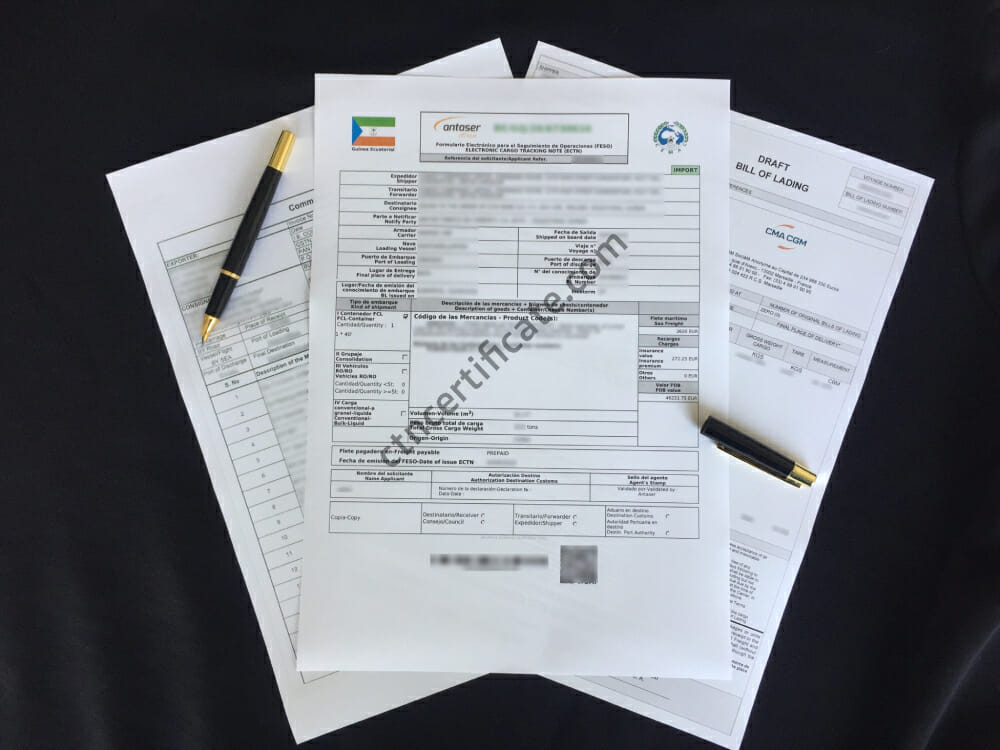
ECTN stands for Electronic Cargo Tracking Note. This certificate allows Equatorial Guinea authorities to effectively track, manage, and supervise all shipments from loading to discharge. It provides essential information about shipments before they reach their destination, including comprehensive details about the exporter, importer, transported goods and their value, freight cost, shipment type, vessel name, and more.
The ECTN is part of a family of cargo tracking certificates used across Africa. Different countries use different names for the same type of certificate — for example, it’s called BSC/BESC in French-speaking West Africa, FERI in DR Congo, and BIETC in neighboring Gabon. Over 25 African nations require similar certificates.
What are the required documents?
- Bill of Lading: This is a document that includes details about the exporter, the importer, the weight of the goods, the shipping line, the vessel name, etc.
- Commercial Invoice: It contains details of the goods, the freight cost, the incoterm, and some other charges if there is any, etc.
- Freight Invoice: It is only necessary if the freight cost is not on the commercial invoice.
- Export Customs Declaration: Customs Officials of the exporter country prepares this document, and it lists the goods being transported and contains some important details of them.
Make sure all documents are accurate and complete before submission. See our guide on the top 20 mistakes to avoid when getting a CTN to prevent costly errors.
What are the consequences of not having it?
According to the regulation, it is mandatory for the certificate to be delivered at least five days before the vessel’s arrival, and this is the latest acceptable timeframe. Failure to comply may result in a fee equivalent to twice the amount of the ECTN cost, in addition to the regulation fee determined by the Equatorial Guinea National Port Officials.
Non-compliance can also result in cargo being held at port, leading to demurrage and storage charges that quickly exceed the certificate cost. Learn more about why outsourcing your CTN to an experienced provider helps avoid these risks.
Pricing
Certificate cost depends on the number of Bill of Ladings and the containers, the country of origin, the port of discharge, etc. If you share your shipment’s details with us we can send you an exact quote for your certificate. We offer free quotations — contact us or see our pricing page for more details.
How long does it take to get Equatorial Guinea ECTN certificate?
We provide draft Equatorial Guinea ECTN certificate the same day. We provide certificates to exporters all over the World.
Which ports in Equatorial Guinea require ECTN certificate?
All ports in Equatorial Guinea require an ECTN certificate. Equatorial Guinea is unique in Africa as it consists of a mainland region (Río Muni) and several islands. The major ports include:
- Port of Bata:
Located on the mainland (Río Muni), the Port of Bata is the largest port in Equatorial Guinea and handles the majority of the country’s commercial cargo. - Port of Malabo:
Located on Bioko Island, Malabo is the capital city. The port serves as the primary gateway for the island and handles both commercial cargo and oil industry supplies. - Port of Luba:
Also on Bioko Island, the Port of Luba is a deepwater port primarily serving the offshore oil and gas industry. It has been significantly expanded to support petroleum operations.
Related Certificates You May Need
If you’re shipping to or through countries neighboring Equatorial Guinea, you may also need one of these certificates:
- Gabon BIETC — required for cargo entering Gabon, which borders Equatorial Guinea’s mainland
- Cameroon BESC — required for cargo entering Cameroon, Equatorial Guinea’s northern neighbor
- Republic of Congo ECTN — required for cargo entering Congo-Brazzaville
- Nigeria ICTN — required for cargo entering Nigeria, accessible from Bioko Island
Learn about all the different names of ECTN by country or read our guide on how to choose the right CTN service provider.
Memberships and certifications
Membership

Certifications
- ISO 9001:2015Quality management
- ISO 14001Environmental management
- ISO/IEC 27001Information security management
Related countries
- Central AfricaGabon (BIETC)Bordereau d'Identification Électronique de Traçabilité des CargaisonsBefore departure4 documents
- Central AfricaRepublic of the Congo (ECTN)Electronic Cargo Tracking NoteWithin 5 days of loading4 documents
- Central AfricaAngola (ARCCLA)Agência Reguladora de Certificação de Cargas e Logística de AngolaBefore departure5 documents