






Cameroon
Bordereau Électronique de Suivi des Cargaisons
BESCElectronic cargo tracking note, validated before loading
Shipments to Cameroon need a BESC (Bordereau Électronique de Suivi des Cargaisons). The BESC for Cameroon must be validated at least 48 hours before the vessel arrives.
When is it required?
The BESC for Cameroon must be validated at least 48 hours before the vessel arrives.
Who applies?
The shipper or the freight forwarder files it.
How long does it take?
Draft the same day once the application is complete.
Cameroon BESC guide
Who runs it, where the cargo discharges, and the rules your file is checked against.
- Issuing body
- Conseil National des Chargeurs du Cameroun (CNCC)
- Port of discharge
- DoualaKribi
Rules to know
- The declared freight amount is validated as part of the BESC, so a separate freight invoice is needed when freight is not on the commercial invoice.
Documents to prepare for Cameroon
Tick what you already have. Send them when the list is complete, or send what you have now and we tell you what is missing.
List from our operations team, updated 20 July 2026.
Before you apply
Send your documents, we check them first
Upload the draft bill of lading or invoice. We check the details the BESC needs and tell you what to fix before anything is filed.
- Your files go only to our certificate team.
- You decide whether to apply after our reply.
In 2006, Cameroon Authorities implemented a new regulation requiring all shipments to Cameroon to have a BESC certificate. Without it, shippers face severe consequences and a penalty. However, for those using Cameroon for transit purposes, there are some cases where a BESC may not be necessary. Click here to learn more about transit shipments. The BESC is mandatory for all ports in Cameroon, including Douala, Kribi, and others.
Although the BESC is mandatory and crucial for the shipping process, it remains one of the most overlooked certificates.
What is Cameroon BESC?
BESC stands for Bordereau Électronique de Suivi des Cargaisons, which translates from French to Electronic Cargo Tracking Note, ECTN. The name ECTN itself reveals much about its purpose. It is designed to enable authorities to track, manage, and supervise cargoes from loading to discharge, in addition to providing information about the shipments before they reach the destination port. This certificate contains details about the exporter, the importer, the goods being transported and their value, the freight cost, the type of shipment, the vessel’s name, and more.
What are the required documents?
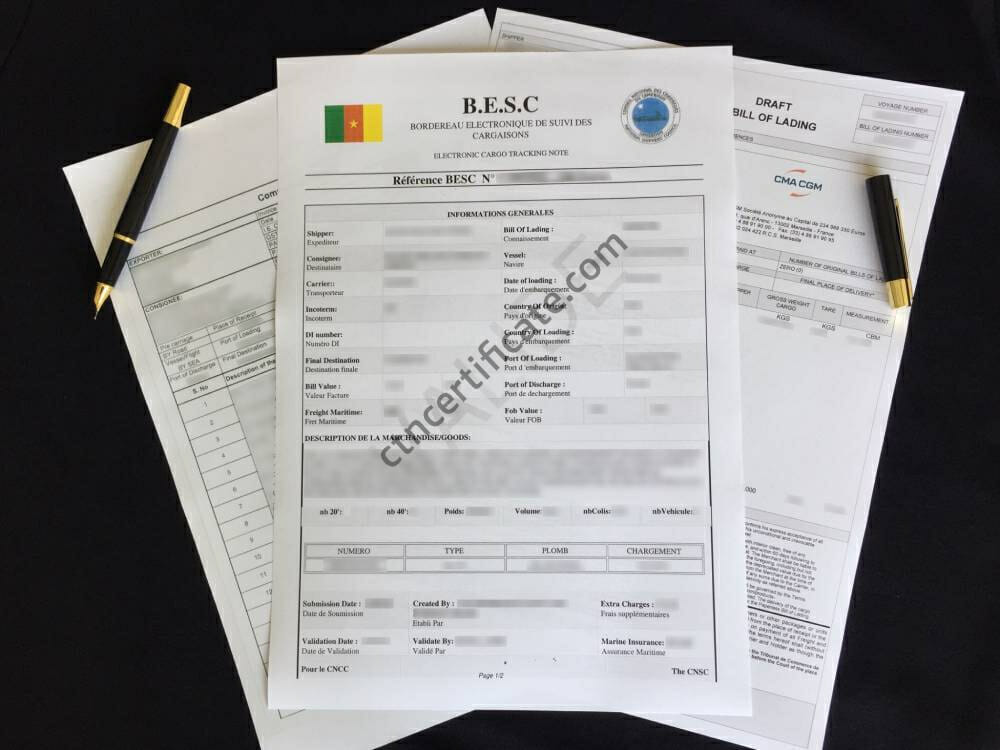
- Bill of Lading: This is a document that provides information about the exporter, the importer, the weight and volume of the goods, the shipping line, the vessel name, etc.
- Commercial Invoice: This document contains the details of the goods, the incoterm, the freight cost, and some other charges like insurance, etc.
- Freight Invoice: This is a document that is only necessary if the freight cost isn’t on the commercial invoice.
- Import Declaration: It’s a document that provides information about the importer, the type of transport, etc. The importer has to provide it, and it has to contain a Tax Payer’s ID, a PR number, and an SGS number.
New RORO Shipping Requirement – May 2025:
All RORO vehicle shipments must now be accompanied by:
- Proof of FIMEX registration or
- A Special Import Authorization
What are the consequences of not having the BESC certificate?
The BESC certificate must be validated five days before the vessel arrives at the latest. If it isn’t validated, by then, you’d have to pay twice the amount of the BESC cost plus the regulation charges determined by the Cameroon National Port Officials.
Pricing
Certificate cost depends on the number of Bill of Ladings and the containers, the country of origin, the port of discharge, etc. This is why we can’t give you an exact price for the CTN. But if you share your shipment’s details with us we can send you an exact quote for your certificate. We offer free quotation.
How long does it take to get Cameroon BESC certificate?
We provide draft Cameroon BESC certificate the same day. We provide certificates to exporters all over the World.
Which ports in Cameroon require (cargo waiver) BESC certificate?
- Port of Douala:
Located in the city of Douala, the Port of Douala is the largest and busiest port in Cameroon. It serves as the main gateway for international trade, handling a significant portion of Cameroon’s imports and exports. - Port of Kribi:
Situated in the coastal city of Kribi, the Port of Kribi is a deep-water port that was developed to alleviate congestion at the Port of Douala. It has modern infrastructure and handles containerized cargo, bulk commodities, and petroleum products. - Port of Limbe:
Located in the city of Limbe, the Port of Limbe is an important regional port in Cameroon. It primarily handles exports of oil and gas-related products, as well as imports of general cargo. - Port of Douala-Bonabéri:
This is a specific terminal within the Port of Douala, dedicated to handling containerized cargo. It is equipped with container yards, cranes, and other facilities to facilitate efficient container handling operations. - Port of Tiko:
Situated in the town of Tiko, the Port of Tiko is a smaller port that mainly handles exports of cocoa and other agricultural products. It is strategically located near the cocoa-producing regions of Cameroon
What are the most imported items in Cameroon?
- Petroleum products: Including gasoline, diesel, and other refined petroleum products.
- Machinery and mechanical appliances: Such as machinery parts, generators, pumps, and electrical machinery.
- Vehicles and automotive parts: Including cars, trucks, motorcycles, and their components.
- Pharmaceuticals and medical equipment: Including medicines, medical instruments, and healthcare supplies.
- Iron and steel products: Such as iron rods, steel structures, and construction materials.
- Electrical machinery and equipment: Including electronic devices, appliances, and telecommunications equipment.
- Rice: Cameroon imports rice to meet domestic consumption needs.
- Wheat: Wheat is imported for various purposes, including bakery and food processing.
- Plastics and plastic products: Including plastic materials, packaging, and household items.
- Textiles and clothing: Including fabrics, garments, and apparel.
Which countries are the biggest exporters to Cameroon?
- China
- Nigeria
- France
- Belgium
- Germany
- United States
- India
- Netherlands
- United Arab Emirates
- Thailand
- Italy
- South Korea
- Spain
- Switzerland
- United Kingdom
- Turkey
- Brazil
- Malaysia
- Canada
- Russia
Memberships and certifications
Membership

Certifications
- ISO 9001:2015Quality management
- ISO 14001Environmental management
- ISO/IEC 27001Information security management
Updates for Cameroon

 BESCCameroon: transit BESC suspended for cargo to Chad and the Central African RepublicCameroon has temporarily stopped requiring its own BESC for transit cargo moving through Douala to Chad or the Central African Republic.
- BESCCameroon: BESC also required for transit cargo from 1 January 2026From 1 January 2026, Cameroon requires a BESC not only for imports but also for all transit shipments to or through Cameroon.
- BESCCameroon: FIMEX registration or special import authorisation for RoRo vehiclesFrom 1 May 2025, the Cameroon National Shippers’ Council requires, for RoRo vehicles, either proof of FIMEX registration (importers/exporters file) or a valid special import authorisation before the final certificate is issued.
Related countries
- Central AfricaCentral African Republic (BESC)Bordereau Électronique de Suivi des CargaisonsOriginal B/L within 5 days5 documents
- Central AfricaChad (BESC)Bordereau Électronique de Suivi des Cargaisons2 days before arrival3 documents
- Central AfricaDR Congo (FERI)Fiche Électronique de Renseignement à l'Importation5 days before arrival6 documents