






Burundi
Bordereau Électronique de Suivi des Cargaisons
BESCElectronic cargo tracking note, validated before loading
Shipments to Burundi need a BESC (Bordereau Électronique de Suivi des Cargaisons). Once the BESC reference for Burundi is issued, the original bill of lading must follow within 5 days, or the certificate is cancelled.
When is it required?
Once the BESC reference for Burundi is issued, the original bill of lading must follow within 5 days, or the certificate is cancelled.
Who applies?
The shipper or the freight forwarder files it.
How long does it take?
Draft the same day once the application is complete.
Burundi BESC guide
Who runs it, where the cargo discharges, and the rules your file is checked against.
- Issuing body
- Burundi Revenue Authority (OBR) / Maritime Authority
- Port of discharge
- Bujumbura (via Dar es Salaam)
Rules to know
- The BESC number is issued at validation, so it cannot be given in advance.
- The final, dated master bill of lading is needed before validation.
- Shipper, consignee and notify party addresses must be the same on every document.
- The weight on the export declaration must match the bill of lading.
- The statistical value on the export declaration must match the commercial invoice.
- For shipper-owned containers, the tare weight must be shown on the bill of lading.
- The BESC number can be passed to the shipping line to obtain the bill of lading number; validation needs the final bill of lading.
- A pre-validated certificate must be completed within its validity period, or it is cancelled.
Documents to prepare for Burundi
Tick what you already have. Send them when the list is complete, or send what you have now and we tell you what is missing.
List from our operations team, updated 4 August 2026.
Before you apply
Send your documents, we check them first
Upload the draft bill of lading or invoice. We check the details the BESC needs and tell you what to fix before anything is filed.
- Your files go only to our certificate team.
- You decide whether to apply after our reply.
Burundi has implemented a regulation that makes the ECTN certificate mandatory for all shipments destined for Burundi. Failing to obtain this certificate can lead to severe consequences and penalties.
Because Burundi is a landlocked country, it often relies on the ports of its Eastern neighbors for maritime shipments. However, if your cargo originates from West Africa, you may also need an ECTN certificate for the Democratic Republic of Congo or Cameroon.
Despite being a mandatory and crucial certificate, it is unfortunately one of the most missed and overlooked requirements.
What is Burundi ECTN?
ECTN stands for Electronic Cargo Tracking Note, and its name is self-explanatory. It empowers authorities with the ability and information to track, manage, and supervise shipments from loading to discharge. Additionally, it provides authorities with information about shipments even before they arrive at their destination. The ECTN includes details about the exporter, importer, information about the transported goods and their value, freight cost, shipment type, vessel name, and more.
What are the required documents?
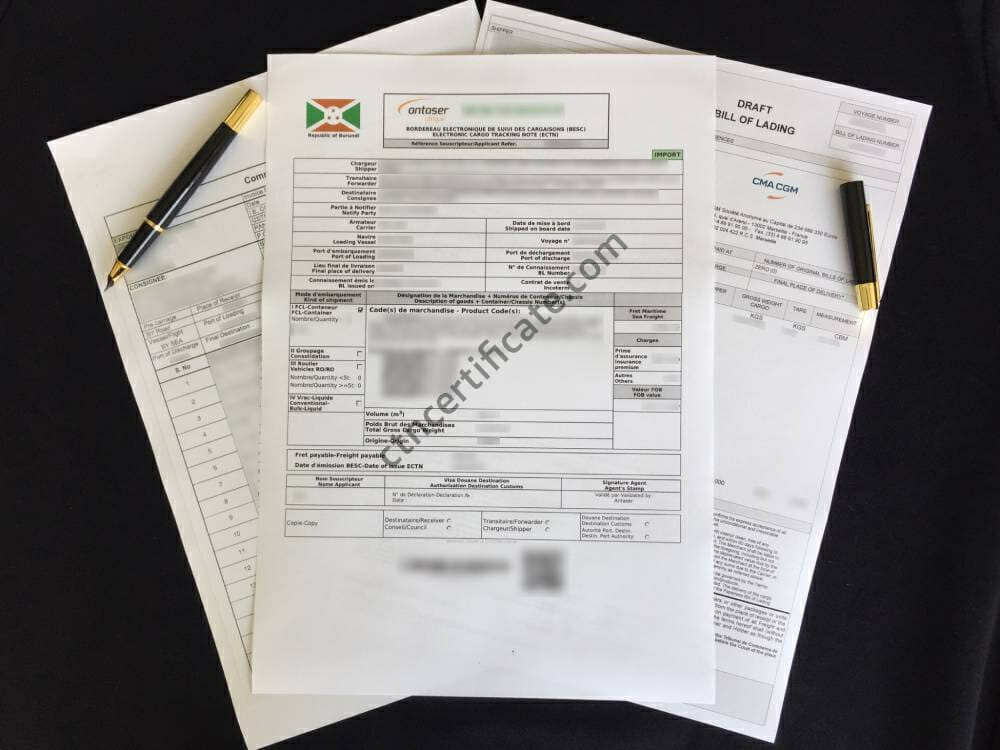
- Bill of Lading: It contains details about the exporter, the importer, the weight of the goods, the shipping line, the vessel name, etc.
- Commercial Invoice: It contains the details of the goods, the freight cost, the incoterm, and some other charges if there is any, etc.freight cost, etc.
- Freight Invoice: This is only required if the freight cost is not on the commercial invoice.
- Export Customs Declaration: Customs Officials of the exporter country prepares this document, and it lists the goods getting transported and contains some important details of them.
- Packing List: This document contains all the details of the goods, especially the total weight.
What are the consequences of not having it?
The ECTN must be validated at least five days before the ship’s arrival, and this is the latest possible deadline. Failure to validate it by then will result in a penalty amounting to twice the cost of the ECTN, in addition to the regulation charges determined by the Burundi National Port Officials.
Pricing
Certificate cost depends on the number of Bill of Ladings and the containers, the country of origin, the port of discharge, etc. This is why we can’t give you an exact price for the CTN. But if you share your shipment’s details with us we can send you an exact quote for your certificate. We offer free quotation.
How long does it take to get Burundi ECTN certificate?
We provide draft Burundi ECTN certificate the same day. We provide certificates to exporters all over the World.
Which ports in Burundi require (cargo waiver) ECTN certificate?
Burundi is a landlocked country and does not have direct access to seaports. It relies on neighboring countries’ ports for international trade and import/export activities.
The top ports that are commonly used for shipping goods to and from Burundi are:
- Port of Dar es Salaam (Tanzania):
Located in Tanzania, the Port of Dar es Salaam serves as a major transit point for Burundi’s international trade. It is the closest and most commonly used port for importing and exporting goods to and from Burundi. - Port of Mombasa (Kenya):
Situated in Kenya, the Port of Mombasa is another important gateway for Burundi’s international trade. Goods are transported by land from Burundi to Mombasa for shipping to various destinations. - Port of Djibouti:
Although not directly adjacent to Burundi, the Port of Djibouti is occasionally used for shipping certain types of cargo to and from Burundi. It provides access to the Red Sea and international shipping routes. - Port of Dar es Salaam Inland Container Depot (ICD): In addition to the seaport, the Inland Container Depot (ICD) located in Dar es Salaam is used for container handling and inland transportation of goods to and from Burundi.
- Port of Mombasa Inland Container Depot (ICD): Similar to Dar es Salaam, the Inland Container Depot (ICD) located in Mombasa serves as a point for container handling and transportation to and from Burundi.
What are the most imported items in Burundi?
- Petroleum products: Including gasoline, diesel, and other refined petroleum products.
- Machinery and mechanical appliances: Such as machinery parts, generators, pumps, and electrical machinery.
- Vehicles and automotive parts: Including cars, trucks, motorcycles, and their components.
- Rice: Burundi imports a significant amount of rice to meet domestic consumption needs.
- Pharmaceuticals and medical equipment: Including medicines, medical instruments, and healthcare supplies.
- Iron and steel products: Such as iron rods, steel structures, and construction materials.
- Electrical machinery and equipment: Including electronic devices, appliances, and telecommunications equipment.
- Wheat: Burundi imports wheat for its flour and bakery industry.
- Textiles and clothing: Including fabrics, garments, and apparel.
- Dairy products: Burundi imports dairy products such as milk, cheese, and butter to meet domestic demand.
Which countries are the biggest exporters to Burundi?
- China
- United Arab Emirates
- India
- Kenya
- Belgium
- United States
- France
- Tanzania
- Uganda
- Germany
- Netherlands
- South Africa
- Switzerland
- Malaysia
- Turkey
- United Kingdom
- Italy
- Japan
- Thailand
- Spain
Memberships and certifications
Membership

Certifications
- ISO 9001:2015Quality management
- ISO 14001Environmental management
- ISO/IEC 27001Information security management
Related countries
- Central AfricaCameroon (BESC)Bordereau Électronique de Suivi des Cargaisons48 hours before arrival4 documents
- Central AfricaCentral African Republic (BESC)Bordereau Électronique de Suivi des CargaisonsOriginal B/L within 5 days5 documents
- Central AfricaChad (BESC)Bordereau Électronique de Suivi des Cargaisons2 days before arrival3 documents